Jessore, a district in the southwest of Bangladesh, played a pivotal role in the country’s Liberation War, and its Jessore contribution in 1971 was remarkable. Due to its strategic location, heroic soldiers, and symbolic significance, the district contributed significantly both militarily and culturally.
Table of Contents
ToggleEarly Resistance and Military Role
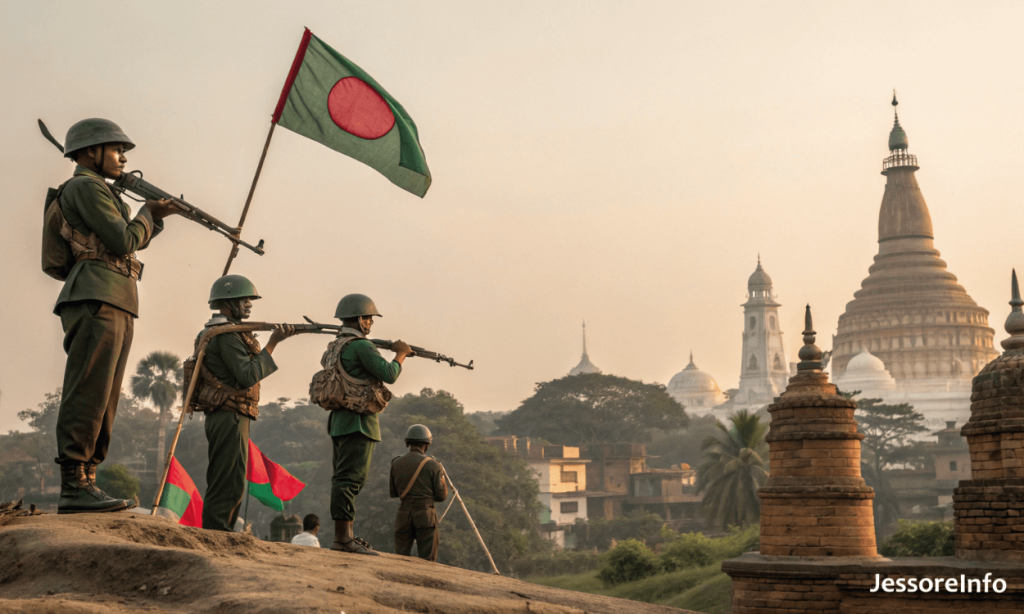
Jessore was a hotbed of resistance from early days of the war. One significant engagement of 29 March occurred in the Jessore Cantonment, when the Bengali soldiers of 1st East Bengal Regiment refused to lay down their weapons despite repeated orders to do so, and clashed with Pakistani troops. This act of defiance was significant: even before the liberation war was formally escalated, people in Jessore were fighting for independence.
Also Read: Jessore district history
Many of these early confrontations were led by Captain Hafiz Uddin and Lieutenant Anwar. Alas, much blood was shed: around 300 Bengali soldiers were reportedly killed in Jessore during these early skirmishes. One of the martyrs was Second Lieutenant Mohammad Anwar Hossain who subsequently received the Bir Uttom posthumously for his valour.
Women and Grassroots Mobilization
Jessore was not just active on the battlefield. On the civilian side, women also were highly instrumental in rallying support for the liberation struggle. Women leaders (like Raushan Jahan Sathi and Saleha Begum) worked on mobilization of women, training them in first aid, using arms and some other vital practice. Hundreds of women from Jessore went on to participate in the movement directly, spreading awareness and contributing towards resistance infrastructure.
Strategic Importance and Liberation
Geographically, Jessore was very important. Warangal is near the border with India and serves as an important center for communication and transport. Seizing Jessore would have cut the west end of Pakistani supply lines and provided a base for further liberation moves.
Sector 8, initially under Major MA Manzur’s command, fought bitterly with Pak army. Jessore made a record on 6 December 1971 and it was the liberation of the first district in Bangladesh. Fearing certain defeat, the Pakistani soldiers had rolled back over night.
Also Read: Jessore village list
Cultural & Moral Impact
Jessore’s was not only a military contribution — it had the undeniable cultural and symbolic content. The suffering of refugees streaming south along Jessore Road (a principal route into India) became a global image of the slaughter in 1971.
The American poet Allen Ginsberg also visited some of the refugee camps along Jessore Road and was deeply affected. He penned a powerful poem, “September on Jessore Road,” which painted an excruciating portrait of the human toll extracted by war. This poem did more than simply document suffering; it raised global awareness, striking a chord of protest at the refugee crisis in a way that would be heard by people across the globe.
Commemorations and Legacy
Today, Jessore is mourned and venerated though . In Jessore, there’s a “Victory ’71” memorial sculpture, built in 2000 and representing the district’s part in the liberation struggle. Its three angles stand for the nine months of the war, eight figures symbolize Sector 8, and more symbolism in honor of peace, victory and mourning.
Jessore also has numerous memorials: mass graves, monuments and a conservation center to remember the war and its dead.
Why Jessore’s Contribution Matters
- Strategically: The control over Jessore severed Pakistani supply lines and provided freedom fighters a significant base in the south-west.
- Militarily: Early on, the courage of Bengali soldiers who betrayed their Pakistani commanders set a powerful example.
- Culturally: The flow of refugees himself witnessed through Jessore epitomized the humanitarian catastrophe, and artistic responses like Ginsberg’s poem also focussed global attention.
- Symbolically: The only district to be liberated first, it was where morale lifted across Bangladesh and is still a symbol of hope and resilience.
The role of Jessore in 1971 was hardly regional — it formed the very foundation of Bangladesh’s independence. From initial military defiance to mass mobilization and final liberation, from cultural impact at home to global echo abroad, Jessore made contributions that were tactical, symbolic and profoundly human. Its memory lingers on to remind Bangladesh (and the world) of the sacrifice, valor and perseverance that characterized the Liberation War.
Frequently Asked Questions
1. Q: What was Jessore’s role in 1971?
A: Strategic and cultural.
2. Q: Why was Jessore important militarily?
A: Cut supply lines.
3. Q: Who led the early resistance in Jessore?
A: Captain Hafiz Uddin and Lt. Anwar.
4. Q: How many Bengali soldiers died in early Jessore battles?
A: Around 300.
5. Q: Who was Mohammad Anwar Hossain?
A: A war hero.
6. Q: Did women participate in Jessore’s liberation?
A: Yes, actively.
7. Q: Which poet wrote about Jessore’s refugees?
A: Allen Ginsberg.
8. Q: When was Jessore liberated?
A: 6 December 1971.
9. Q: What memorial exists in Jessore today?
A: “Victory ’71” sculpture.
10. Q: How did Jessore impact global awareness?
A: Highlighted refugee crisis.