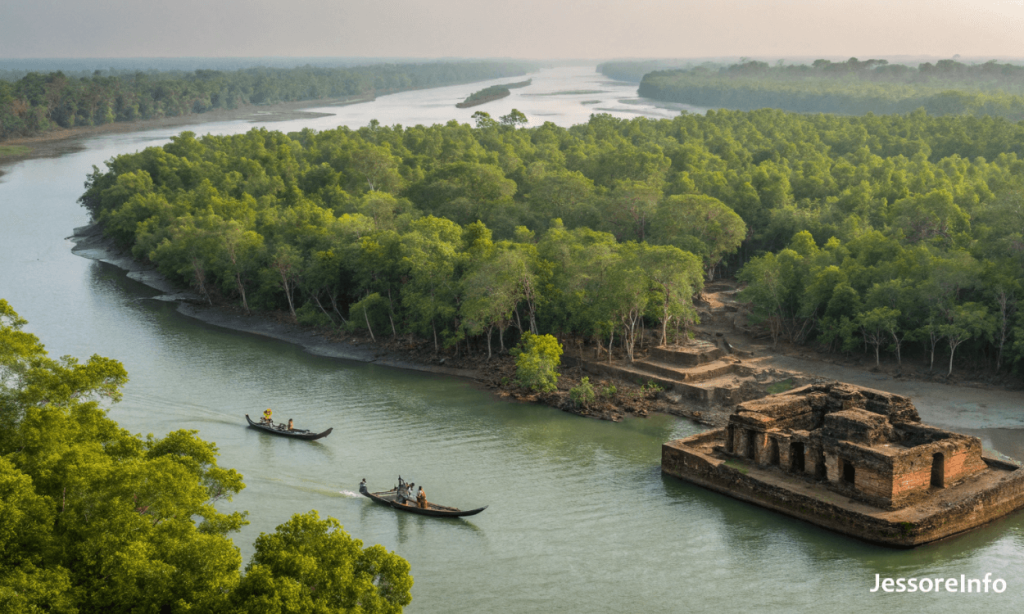
Sundarbans — the name alone is dreamlike. This is not just a forest but THE largest mangrove forest in the world, a UNESCO World Heritage Site and an environmental treasure trove, and to be honest, one of the most awe-inspiring landscapes on Earth. To truly feel its soul, you have to look back at the history of Sundarban, where nature, myth, and human survival have been intertwined for centuries.
Table of Contents
ToggleHistory of Sundarban
Extending across the delta at the confluence of the Ganges, Brahmaputra and Meghna rivers, where they empty into the Bay of Bengal, tens of thousands of square kilometres are described by a terrain that cuts through both Bangladesh and India. Or nearly 60% of it does — in Bangladesh.
Yet the enduring thing about this place is more than just scale…
Also Read: Jessore District History
🌱 The Early Days — Stage Setting
It was way back in the Mauryan period (circa 4th-2nd century BCE) that people began to explore and settle around the mangrove fringes. Archaeological excavations have turned up ruins near Kapilmuni that are evidence humans were living just outside this wild place long before it was well known — quite possibly associated with the semi-mythical Bengali trader Chand Sadagar.
There was not a whole lot of formal control over such watery wilderness during the Mughal era. The forest was let out in tracts by the local rulers, and people started taking only wood, honey, resources — basically living off the land.
📜 Colonial Times — Charting the Mangroves
Then, in 1757, came the British. And they were not just here for tea and spices; they wanted to comprehend and govern everything they could. They were formally granted proprietary rights to the Sundarbans region by the Mughal Emperor Alamgir II. By 1764, they had surveyed this vast maze of rivers and woods — perhaps the earliest detailed effort by any organized power.
But mapping was only the beginning. The first forest management division in the Sundarbans was in place by 1869. A portion of this giant mangrove was declared “reserved forest” within a few years, under British Indian law — essentially among the first moves in conservation.
So yeah — one of the world’s greatest forests went from rough-and-tumble “wild frontier” to managed ecological treasure in just a few short decades.
Also Read: Famous Person of Jessore District
🐅 Modern Era — Conservation and Tourism Combine
Fast-forward to the 20th and 21st centuries, and the Sundarbans are not just history — they’re heritage.
Today, the Sundarbans ecosystem of Bangladesh is a biodiversity-rich sanctuary :
- World-famous Royal Bengal Tigers
- Saltwater crocodiles
- Spotted deer
- Hundreds of bird species
- Specialised mangrove flora that have adapted to life in a tidal environment.
This spot is not just a bit of scrubland — it’s an ecosystem that plays a crucial role in protecting the coastline, sequestering carbon and even generating some economic dividends, courtesy of tourism.
(Note that travel restrictions are also in place seasonally at times to protect the animals — during monsoon or mating seasons, for example – so be sure to check on current policies before you book your trip.)
📍 Cultural & Environmental Importance
It’s not just nature at Sundarban — it’s a cultural icon. Nasty, accusatory songs remain sung; wild stories and traditions become woven with reference to this mysterious green world of rivers and trees. The legends of Bon Bibi, the forest spirit, are frequently retold; they demonstrate how mankind has admired and feared this land for generations.
Also Read: Jessore picnic spot
The Sundarban is an eco-shield, protecting the mainland of Bangladesh from storm surges, cyclones and other natural disasters. Snared to the sea are its roots and waterways — which limit erosion, thwart storm surges, stop wind-tossed debris; they serve as the bonds of nature’s own storm barrier, a barrier that is becoming more essential now that we live on a rapidly heating planet.
✈️ Jessore to Sundarban — Getting There Like a Boss
Now to the fun part- You’re in Jessore and want to do the Sundarbans? Here’s the lowdown:
🛣️ By Road
By car or taxi: This source estimated the distance as 345+ km, which I’m going to say was accurate based on the fact that it seems like a solid road trip vibe from Jessore down into the Sundarban area.
- Plan on 5-6 hours of driving, depending on traffic.
- Taxis are more expensive but easier; car rides are the thrifty choice if you have the energy of a crew.
🚆 By Train
You could catch a train first from Jessore to a nearby hub like Khulna — an easy-breezy ride if you love scenic rails.
The next stop for most is local transport or boot tours from Khulna to the gateways of the forest.
🚤 Final Stretch
The true path to the heart of the Sundarbans isn’t wheels; it’s boats. From Khulna and Mongla eco-tour boats and guided river safaris penetrate deep into the mangroves. This is where the magic takes place.
🌅 When to Visit & Travel Tips
If you want the vibe — not just the pics — shoot for September to March when the weather is more enjoyable and wildlife viewing happens. Peak monsoon is wild (in more ways than one).
Pack your:
- Bug spray
- Waterproof shoes
- Camera with extra batteries
Respect local rules/divers/guides (trust me, those tigers couldn’t care less about your selfie…).
Also Read: Jessore Travel Guide
The Sundarbans is history, mystery and adventure combined. From old settlements and colonial maps to roaring tigers and tidal rivers, it’s not just a place — it’s an experience. And if you’re hailing from Jessore, it’s completely possible with planning and a sense of adventure.
Frequently Asked Questions
1. What is the History of Sundarban?
It is the story of how the world’s largest mangrove forest evolved over centuries.
2. Where is the Sundarban located?
It lies across southern Bangladesh and eastern India.
3. Why is Sundarban famous?
For Royal Bengal Tigers and its massive mangrove ecosystem.
4. When did people first live near Sundarban?
Around the Mauryan period, 4th–2nd century BCE.
5. Who ruled Sundarban during Mughal times?
Local zamindars under the Mughal Empire.
6. What role did the British play in Sundarban?
They mapped it and made it a reserved forest in the 1800s.
7. Why is Sundarban a UNESCO site?
For its rare wildlife and unique mangrove environment.
8. What animals live in Sundarban?
Tigers, crocodiles, deer, birds, and many fish species.
9. Why is Sundarban important for Bangladesh?
It protects the coast from cyclones and storms.
10. Who is Bon Bibi?
A folk goddess who protects people in the forest.