Jessore Road History (যশোর রোডের ইতিহাস)
Jessore Road isn’t merely a road, but a living, stretching thread of history that stitches together past and present throughout Bengal. From humble beginnings as a pilgrimage route to later becoming a major colonial-era infrastructure project, Jessore Road History stands as a powerful tale of mass migration, cultural memory, and resilience. It served as a lifeline in times of conflict and transformation, carrying countless stories of people who walked, struggled, and survived along its path.
Origins: From filial adoration to a key pass
The history of Jessore road dates back to the early 19th century when a rich zamindar from Jessore — Kali Prasad Poddar (locally known as Kali Poddar) constructed it in about 1840–42. The prelims According to popular tradition he built it so that his mother could go on a pilgrimage and bathe in the Ganges, some nine hundred miles away at Kolkata.
Thousands of bird-catchers worked the road, and within a few years the work was done. Eager to provide shade and ease passage for travelers between Calcutta and Rangoon (modern day Yangon), Poddar planted hundreds (and later even more) of rain-trees along both sides of the road.
Also Read: Jessore District History
What started off as a personal enterprise came to be an important link road between Jessore (now in Bangladesh) and Kolkata in India up to which the route crossed international boundaries.
In short: Jessore Road was an act of personal devotion — that grew into something vastly larger.
Colonial Period & Expansion — Building a Regional Artery
The building of the transportation infrastructure received systematic attention under British colonial rule. As part of those improvements, the road between Jessore and Kolkata was granted a formal designation, and eventually fell into what is now referred to as N706 Bangladesh) – the Jessore–Benapole highway in Bangladesh.
It was a particularly crucial connection: binding the southwestern district of Jessore with Kolkata and beyond, it not only facilitated trade, mobility and cultural exchange across Bengal. The importance of the road was enhanced because it provided access to East and West Bengal.
And Jessore Road was no longer simply a local thoroughfare; it had become a regional artery linking communities, commerce and cultures across frontiers.
Also Read: What is Jessore Famous for
Refugee Road — 1971 and the Liberation War
“It’s one of the most touching parts of the Jessore Road story,” he added, referring to 1971. Wartime had suddenly descended on East Pakistan, and millions were fleeing for their lives, turning Jessore Road into a highway of despair and hope. Tens of thousands of refugees traversed it to escape the violence and persecution, entering sanctuary in India.
The haunting pictures of suffering, hopelessness, longing and collective trauma along Jessore Road made a deep impression. The pain, the human tragedy, the yearning for safety — it all had found its voice in an evocative poem by American poet Allen Ginsberg titled September on Jessore Road. Through his lyrics, the world came to know about the plight of refugees moving across Jessore Road in 1971.
So Jessore Road had not only borne bodies — it also bore history, grief, memory — a testament to struggle and endurance.
Green Heritage — Trees, Memory & Conflict
Besides bricks and tar, the other feature of Jessore Road has been its grand tree-lines. Those same rain-trees planted by Kali Poddar in the 1800s were to become symbolic — of shelter for travelers, sanctuary for refugees and century-old guardians of memory.
As if the years piled up, there were more than 2,000 trees in certain stretches of the road. Some have been standing for more than 180 years.
But as traffic was on the rise and plans to widen the road were in the offing, their days of splendor became uncertain. At one point, they said that thousands of them would have to be cut down to widen the highway.
After outcries and legal action, decisions were reached (at least for now) to keep the trees during upgrades.
The green canopy of Jessore Road is more than a visual pleasure — it is historical, emotional and tied to collective memory.
Modern Status & Development
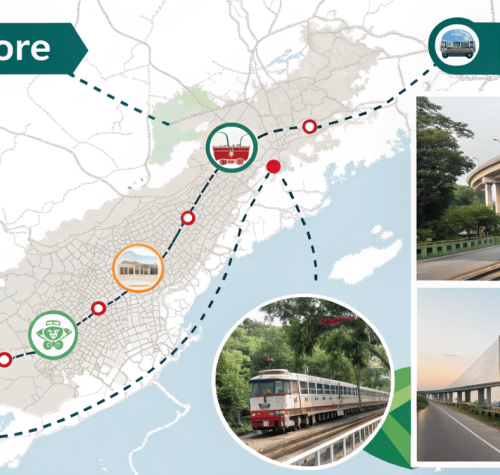
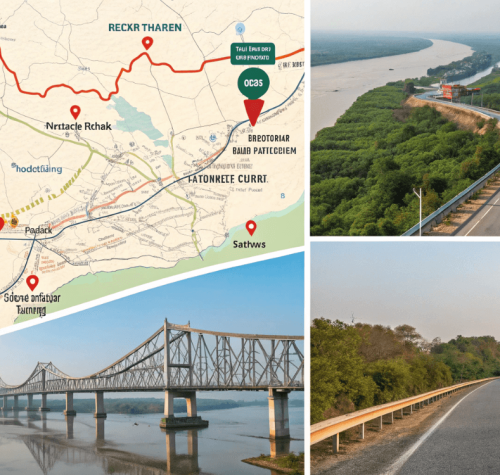
On the Bangladesh side, Jessore Road is known as N706 and runs from Doratana (Jessore “zero point”) to the Benapole border.
Over the last couple of decades, roads and infrastructure throughout Jessore district have undergone large-scale improvements — and local government has worked to upgrade infrastructure by constructing roads, building bridges and expanding connectivity as part of rural development and modernisation schemes.
Nonetheless, the historic Jessore Road — with its heritage trees and heritage — is a delicate balance between development and conservation. The debate between widening for contemporary requirements or maintaining heritage is ongoing.
Also Read: Jessore travel guide
Why Jessore Road Matters
On one level at least, Jessore Road is important:
- The historical through-line — from a zamindar’s personal endeavor to a major cross-border passage.
- Cultural history — the road holds stories of pilgrimage, colonial connections, migration, war, loss and hope.
- Humanitarian symbol — as a road to freedom in 1971 it is burned into the collective memory of both suffering and survival.
- Its trees, its stretches, even its geography are living heritage; it binds generations: what used to shelter refugees now shades all who pass by.
- Relevance today — As infrastructures change, Jessore Road speaks to the tension between progress and preservation; Any path of development is accompanied by a history which it cannot clean.
If you look up “jessore road history,” know this: you’re not looking up a road — you’re following in the footsteps of thousands, moving across decades and layers of human experience. Jessore Road is proof: of the devotion of a single man, of colonial connectivity and then the agony and optimism of refugees — and finally, today’s ambition and responsibility.
Frequently Asked Questions
1. What is Jessore Road known for?
Ans: Its historical and cultural significance.
2. Who originally built Jessore Road?
Ans: Kali Prasad Poddar.
3. Why was Jessore Road built?
Ans: For his mother’s pilgrimage.
4. What trees are famous along Jessore Road?
Ans: Rain-trees.
5. What was Jessore Road’s role in 1971?
Ans: A major refugee route.
6. Which poet wrote about Jessore Road?
Ans: Allen Ginsberg.
7. What is Jessore Road called today in Bangladesh?
Ans: N706 highway.
8. Why are the trees on Jessore Road important?
Ans: They’re historic and symbolic.
9. Is Jessore Road still used as a major route?
Ans: Yes.
10. Are the historic trees protected?
Ans: Mostly, yes.